Inventory & Sales Intelligence Platform
Inventory and sales platform: a Go/Gin REST API with role-based access control, a Flutter admin app and a Python forecasting service, verified by 1,613 automated tests and CI.
- Solo developer (personal project)
- October 2026
- Personal Project
- Go · Gin · GORM · PostgreSQL · Redis · Flutter · Python · FastAPI · Docker
Overview
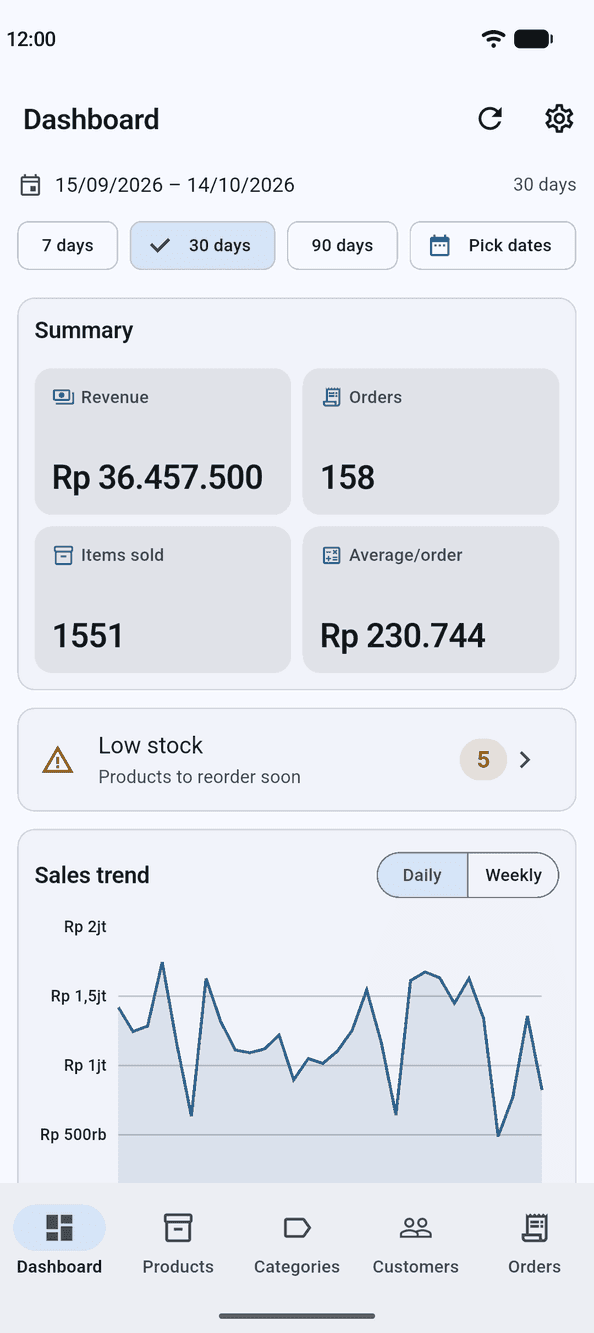
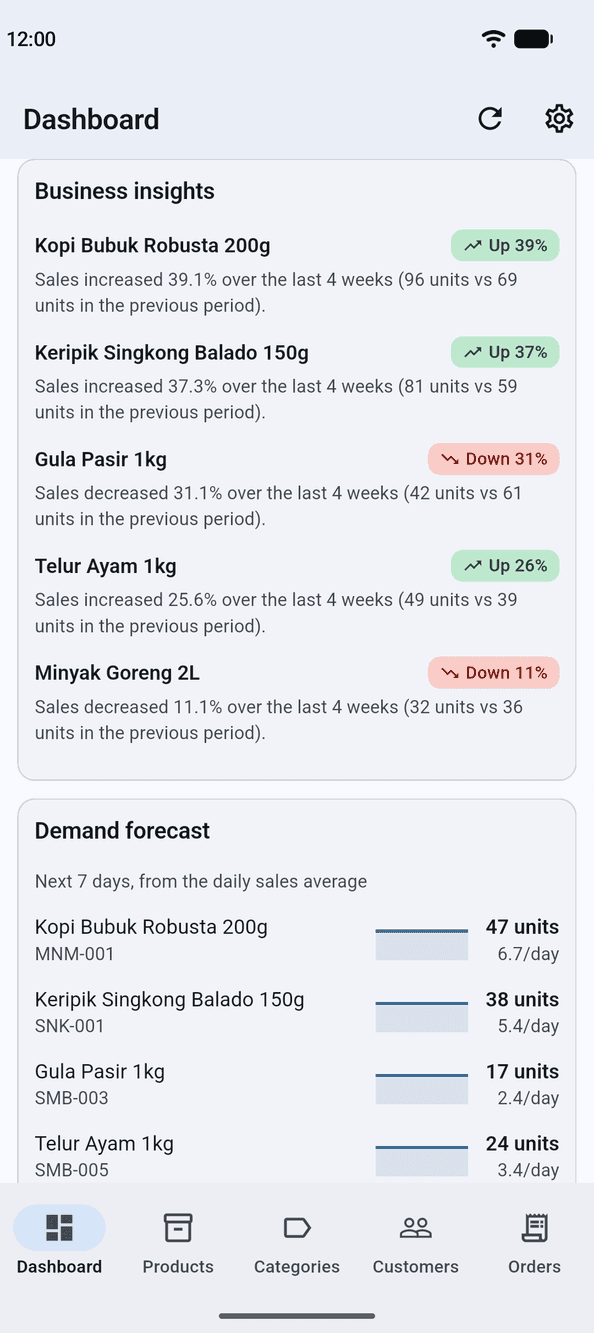
A full-stack inventory and sales intelligence platform built to show how a small-business backend is designed and verified end to end. A Go (Gin, GORM) REST API backed by PostgreSQL and Redis handles authentication, role-based access control, products and stock, sales orders and analytics. A Flutter mobile app gives administrators and staff access to the dashboard, users and roles, and a Python (FastAPI) service produces demand forecasts and trend insights for the Go API.
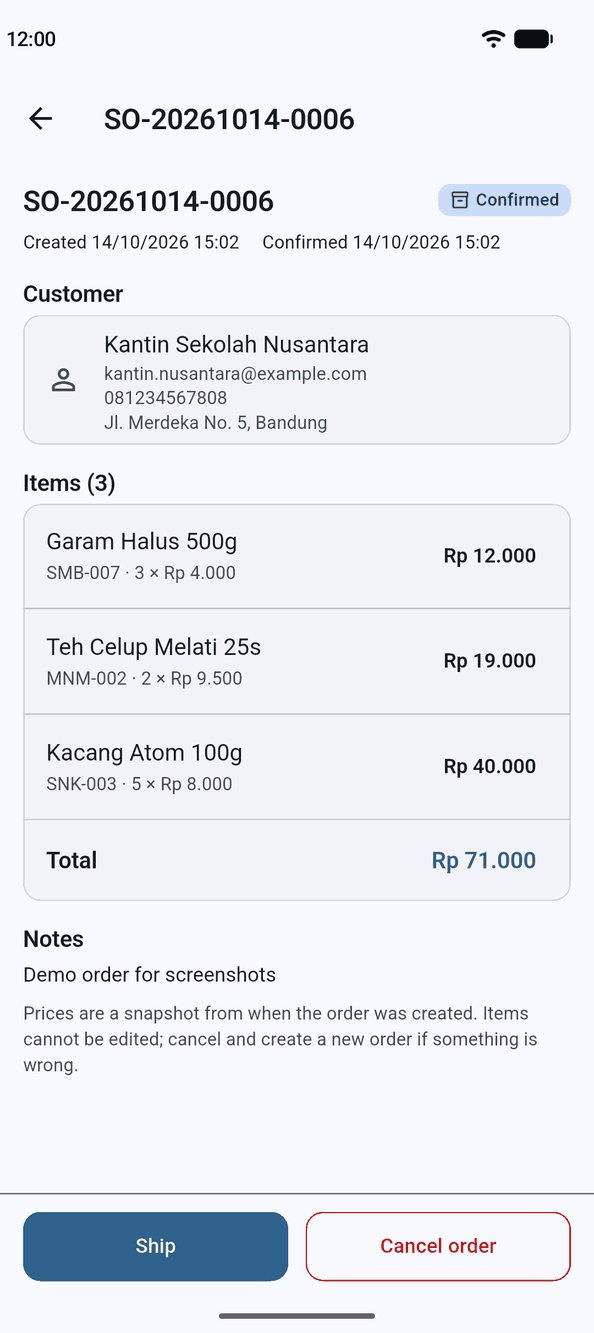
The backend is built around correctness under real conditions. Permissions are checked per resource and action, and a guard ensures a user can only grant roles, and only edit users, whose permissions are a subset of their own. Refresh tokens rotate on every use, and a reused token revokes every session of that user. Stock changes are concurrency-safe, price and totals are snapshotted on each order, and the order status follows a strict state machine. The whole stack runs with one Docker Compose command, and GitHub Actions runs the backend, ML service, Flutter and Docker checks plus an end-to-end suite. The forecast currently uses a moving-average baseline (7-day window), designed so a trained regression model can replace it.
The project is covered by 1,613 automated tests (831 Go tests running against a real PostgreSQL database, 80 Python tests and 702 Flutter tests) and an end-to-end suite of 314 checks in CI. It was developed with the assistance of Claude Code; the idea, the technical decisions and the manual verification, including testing on a physical Android phone, are mine. Source code: https://github.com/dannyalfandi/AI-Powered-Inventory-Sales-Intelligence-System
The problem
A portfolio project to show how a small-business inventory and sales backend is designed and verified end to end: access control, stock that stays correct under concurrent orders, analytics and forecasting.
What I built
- JWT authentication with refresh-token rotation and reuse detection
- Role-based access control with 32 permissions and custom roles
- Anti-privilege-escalation guard for granting roles and editing users
- Product, category, customer and inventory management with stock movement history
- Concurrency-safe stock deduction, verified with parallel requests
- Sales order workflow (pending, confirmed, shipped, cancelled) with price snapshots and stock return on cancellation
- Analytics: summary, sales trend, top products and category breakdown, cached in Redis
- Demand forecast and trend insights from a Python FastAPI service
- Flutter admin app for the dashboard, users and roles, in Indonesian and English
- One-command Docker Compose stack, GitHub Actions CI and an end-to-end test suite
Architecture
// Request flow
- Flutter app
- REST API (Go · Gin · GORM)
- PostgreSQL + Redis cache
// Forecasting
- Go API
- forecast service (Python · FastAPI)
- demand forecast + trend insights
Key decisions
Permissions can only be passed down
Permissions are checked per resource and action, and a guard ensures a user can only grant roles, and only edit users, whose permissions are a subset of their own.
Refresh tokens rotate on every use
A reused refresh token revokes every session of that user, so a stolen token stops working as soon as either side uses it again.
Orders are consistent by design
Stock changes are concurrency-safe, price and totals are snapshotted on each order, and order status follows a strict state machine.
A replaceable forecast baseline
The forecast uses a moving-average baseline (7-day window), designed so a trained regression model can replace it.
Results & what I learned
1,613 automated tests (831 Go tests against a real PostgreSQL database, 80 Python tests and 702 Flutter tests) plus an end-to-end suite of 314 checks in CI. The whole stack starts with one Docker Compose command.
Screens
Dashboard. Demand forecast and trend insights. Sales order detail. Inventory with low-stock items. Role permissions.